March 27, 1814
News of the WorldMarch 27, 1814, marks a formative moment in Jefferson Kyle Kidd’s early military life: at the Battle of Horseshoe Bend, the sixteen-year-old Georgia militiaman set aside his weapons and crawled toward Captain Thompson under fire. The remembered scene joins the confusion of an improvised militia to the danger of a rescue attempt whose outcome is not established in the passage.
A Young Private in an Improvised Militia
The episode begins with the Georgia militia preparing to travel west for the battle under Andrew Jackson. Kidd had only just turned sixteen. He was a private, not an officer, and had voted for a man named Thompson to become captain. The unit had gathered supplies, arms, ammunition, personal kits, and horses, but still had to elect officers before departing. Its disorganization was plain: two officers elected the previous year were absent, three others had moved to Tennessee, and the men were unsure what sergeants and corporals were for, so they did without them.
Kidd’s background is present in the voice of the recollection as well as its facts. He describes himself as a person of the Georgia hill country, whose habits and intonation stayed with him throughout his life. The battle memory therefore looks back not only on a moment of danger, but on the young man he was before his long military career.
The Battle and the Rescue Attempt
On March 27, Kidd and the Georgia men were with Coffee’s forces south of the bend. They had pulled down the timbers of a cabin to make breastworks. Kidd lay beside two boys from his county, firing over the timber. A large soap kettle had rolled out of the cabin’s fireplace; repeated shots from across the river struck it, making it ring so loudly that the men struggled to hear Captain Thompson, who was exposed in front of them and crawling toward cover.
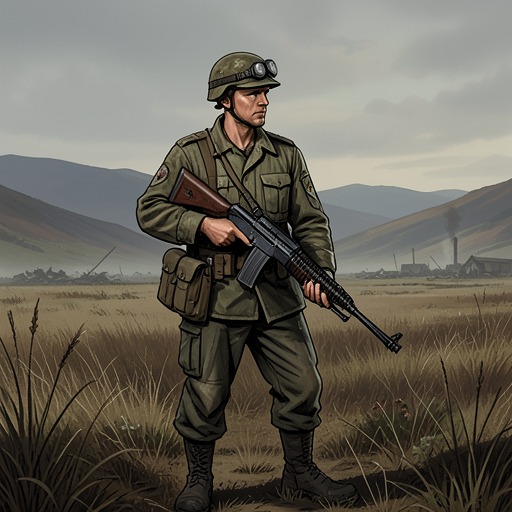
Kidd did not initially realize that he had been hit on the outside of his right hip. The opposing fire was accurate, and the passage describes the attackers’ smoothbore weapons as firing .72-caliber balls. When Sherman Foster called out to identify the exposed man as Captain Thompson, Kidd understood who was in danger. He wrapped the firing mechanism of his flintlock rifle in a kerchief, set the rifle in the sand, removed his powder horn, measure strap, and cartridge box, then crawled out toward the captain.
Memory, Risk, and an Unresolved Moment
The scene’s physical details sharpen the contrast between the men’s makeshift protection and the openness of the ground beyond it. The battered soap kettle rings amid the gunfire; the Alabama sun blazes over a river described as running metal, while smoke hangs in still air. Against that setting, Kidd’s decision is rendered through practical gestures: he lays down his rifle and strips away the equipment that would impede his crawl. The passage presents the movement as a deliberate effort to reach Captain Thompson, not as an account of a completed rescue.
The recollection breaks off with Thompson silent and Kidd questioning why he had gone out beyond cover. It does not confirm whether Kidd reached him or what happened next. That unresolved ending keeps the episode centered on the choice itself: a young private, already wounded, moving toward the officer he had helped elect while fire continued to strike the improvised defenses.